Raising The Alegría Bar
The Mesoamerican inspiration behind Pastry Chef Kelli Huerta’s standout chocolate course at Californios
Photo: Will Blunt
At Californios, the stories behind each dish are an essential part of the dining experience. “I think it’s important to know the story of the dishes,” says Pastry Chef Kelli Huerta. “It not only changes the way that a guest perceives it, but also enjoys it.” This ethos is no different for Huerta’s Alegría bar, the chocolate course on the restaurant’s tasting menu.
“It’s inspired by this pre-Hispanic confection,” says Huerta. “It’s a bunch of fruit, nuts, and seeds. It’s supposed to be like an energy bar that they ate when they were working the land.”
A key component of the bar was amaranth, a pseudocereal and key source of nutrients for the people of Mesoamerica long before the Spanish colonized the region. After colonization, it was outlawed, and the Indigenous population would call the grain “alegría” as a code word, which translates to “happiness.” “I think it’s really important to learn about the nutritional value of things and also what nurtured ancient Mexican societies,” Huerta says.
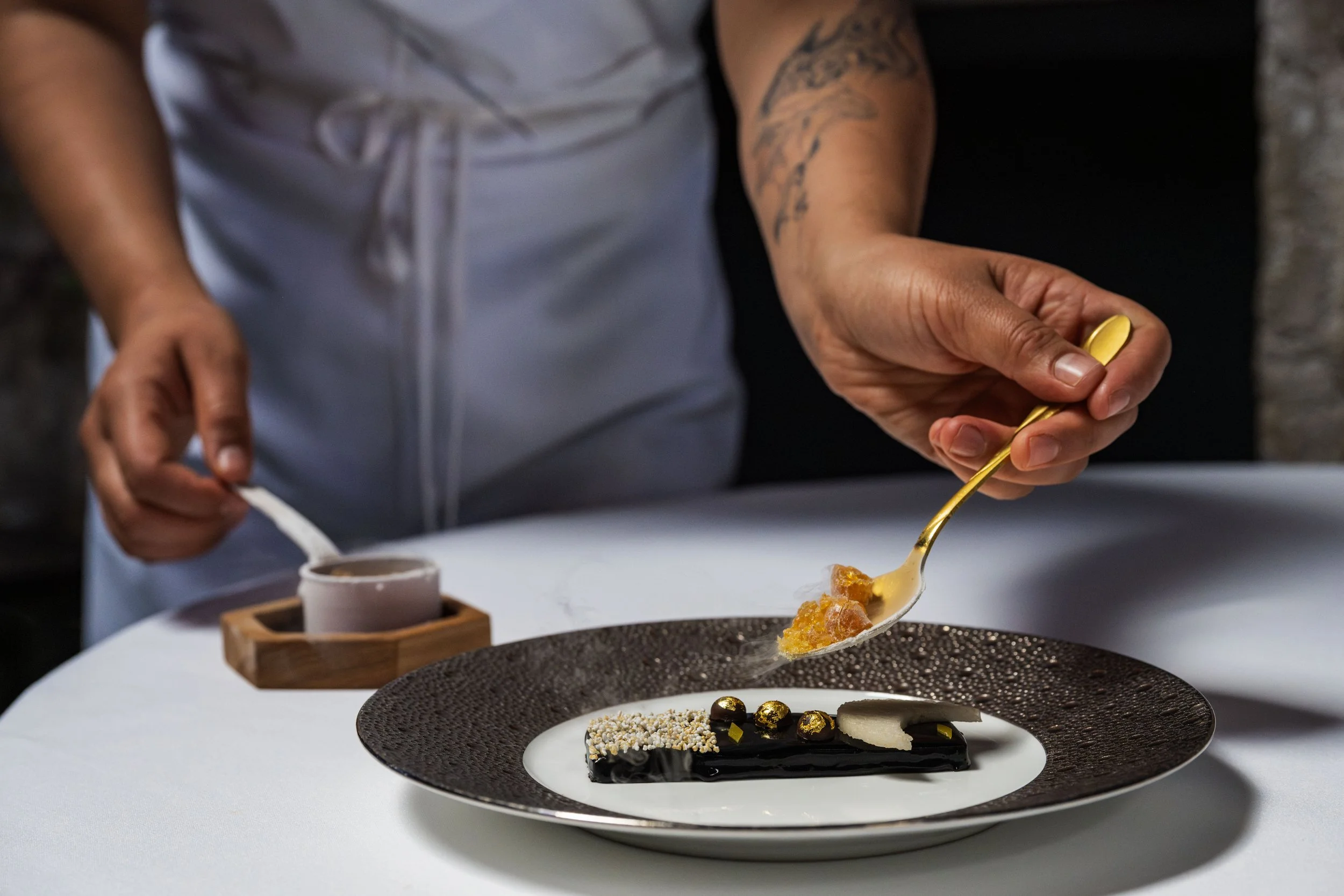
The “trail mix bar” inspiration is reflected in the shape of the dessert: a thin, long rectangle shaped chocolate made of three layers. The process starts by sourcing two different types of regional Mexican chocolate, each 75% cacao, from Chiapas and Tabasco, sourced and roasted by Proyecto Diaz Coffee in Oakland. “Chocolate was a huge part of Mexican culture,” says Huerta. “It was once one of their main forms of currency. It has a lot of value to the culture, which is why we love to have it on the menu.” With the Tabasco chocolate, she makes a crémeux, using a standard custard base that the melted chocolate is folded into. The Chiapas chocolate is combined with a bit of cocoa butter and used to coat a traditional feuilletine.
“The fat preserves the feuilletine so that it still has a bit of a crunch to it once we set it in between the layers,” says Huerta. A ganache makes up the other layer, and consists of Chiapas chocolate set with a bit of gelatin that’s whipped once it cools down.
The striking, jet-black glaze shimmering over the top is made with black cacao powder, water, milk, and lots of gelatin, and is kept at 95°F before service. The chocolate spheres that adorn the plate are made from the Tabasco chocolate and are tempered and set in sphere molds. Semi-hydrated pieces of preserved lemon are then placed in the molds, set, and garnished with gold leaf. To the side of the spheres, Huerta features pieces of seasonal fruit—rotating through produce like Asian pears and strawberries as the year goes on. A third of the bar is garnished with amaranth, which is puffed in-house over a hot pan.
If the heart of the dish is the amaranth, the star of the dish is the honey. The local honey is sourced from Marshall’s Farm, and is steeped with preserved lemon pulp and lemon skin. For service, the honey is drizzled into containers filled with liquid nitrogen, and then poured onto the plate tableside. “It freezes really quickly and then we’re able to bring it up to the guests and they can have an intensely cold yet melt-in-your-mouth texture,” says Huerta.
Huerta’s Alegría bar, a celebration of traditional Mexican foodways, balances the familiar as much as it does the futuristic—appearing like a chocolate bar you might have had as a kid, but simultaneously like an “obelisk from space,” says Huerta.