On The Mezze Table: Kereviz
The lowdown on the high-fidelity celeriac and apple dish gracing the proudly Turkish menu at Hamdi

Photos: Alexander Zeren
At Hamdi, the restaurant co-owned by Chef Berk Guldal and his wife, Kat Schult, the kereviz is a heartfelt homage to the chef’s Turkish roots.
“My mother inspired my wife and I to include this dish on the menu. Every time we go back home to Istanbul to visit, she makes it,” Guldal shares, reflecting on the memories that fuel his culinary innovation.
The original dish, which Guldal has enjoyed since childhood, is rooted in simplicity, featuring a basic preparation of raw celeriac and green apple. However, the former chef de partie at Eleven Madison Park and SingleThread Farm sous chef has turned kereviz into a refined offering that showcases his hard-earned skills while paying homage to his childhood in Istanbul. “There are a lot of memories tied into this dish,” Guldal explains. “That’s why we want to share it with our guests. We want to show them a piece of us, and we believe the kereviz is also really great and tasty.”
HAY-SMOKED YOGURT
The heart of the kereviz is its hay-smoked yogurt, a technique that Guldal uses to impart a warm, earthy note. “The hay-smoked technique is something I developed to give more depth and flavor to the dish. It’s already creamy, a little garlicky, nutty, fresh, and has lots of textures in it,” Guldal says. “I believe the slight smokiness brings a really nice balance to the dish, and it also goes great with our concept—we want all our dishes touched by fire or smoke.”
The chef sources his yogurt from Flying Cow Creamery, a small farm located just an hour from Seattle, which milks only seven cows. “It’s a sour yogurt—and at this stage, we’re just using a straight yogurt, we don’t strain it,” Guldal adds.
To keep the yogurt at a safe temperature, it’s put on ice, he explains. “We also use a lot of ice because it helps create more smoke.” A hotel pan lined with hay is then placed underneath the yogurt and ice and covered with aluminum foil. From there, the hay is torched under the blanket of foil. “We hay-smoke the yogurt for an hour,” Guldal says. This careful method ensures that the yogurt absorbs the aromatic flavors without losing its integrity.
After the yogurt has been properly smoked, a series of raw ingredients are folded into it, including grated raw celery root, green apple, and garlic. White shoyu, molasses, mayonnaise, koji rice liquid, salt, and pepper join the yogurt as the final components that form the creamy base of Guldal’s kereviz. The base is then set aside to marinate for a day, allowing the flavors to meld together. “Whenever you make mezze, it’s always better the next day,” Guldal says.
BROWN BUTTER
Another topping that needs early preparation is the brown butter. Guldal boils the butter in a rondeau over a wood-fired stove. The butter is then whisked over the fire, melted down, and cooked until it turns brown—right before it burns. “There’s a sweet spot there where it gets very nutty and has a very rich flavor,” Guldal explains. The butter is strained after the boiling process, filtering out the liquid, which nets a clear, brown hue.
GARNISHES
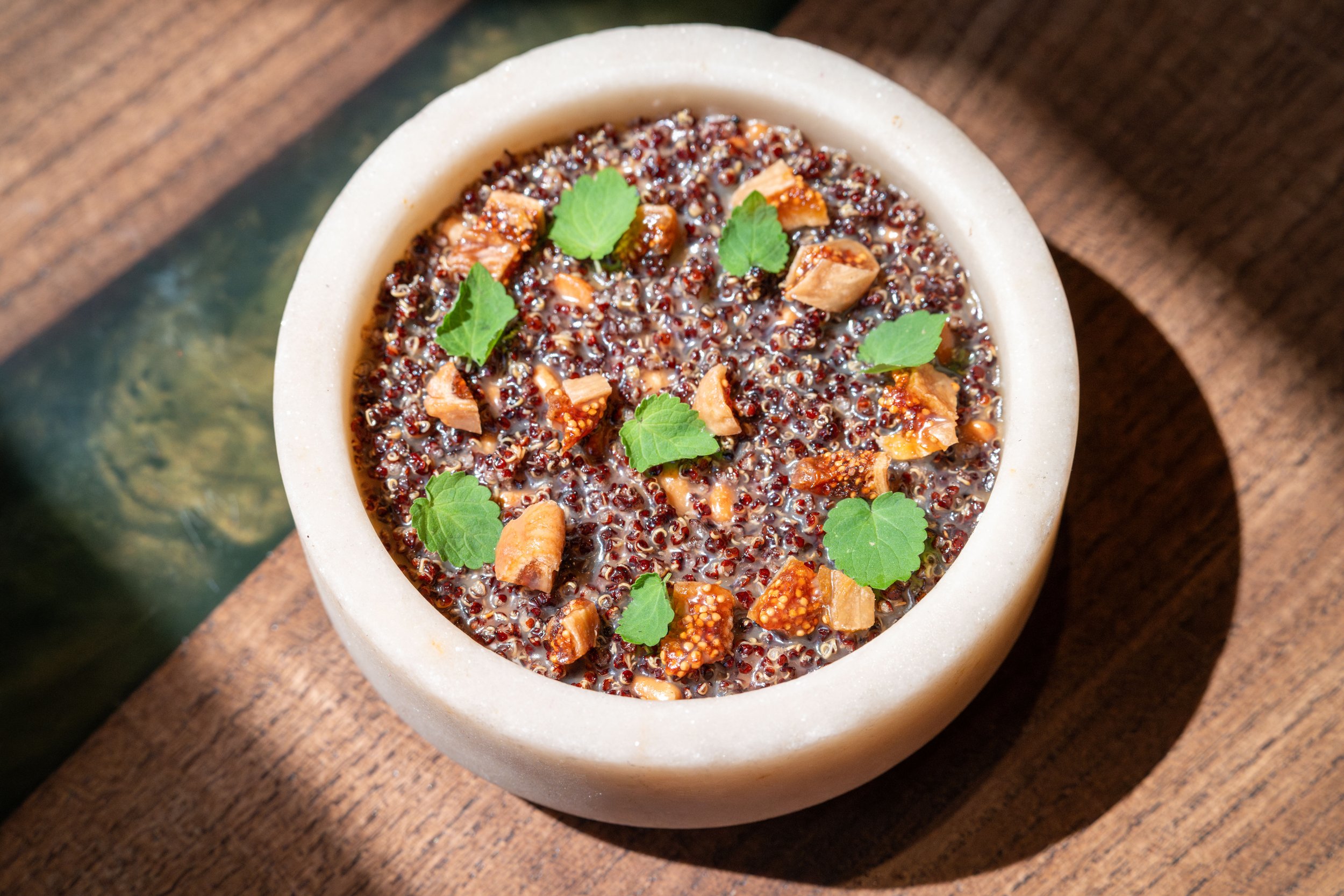
Assembling and topping the kereviz is a thoughtful process that showcases Guldal’s attention to detail. After the base has marinated, it’s spread across a beautiful marble plate and topped with various ingredients. Guldal begins with a sprinkle of yuzu ichimi, a Japanese spice blend that adds a delicate heat. Next, the roasted pine nuts and puffed crispy quinoa are scattered on top to enhance the dish’s crunch factor, followed by diced Turkish sun-dried figs, which introduce a hint of sweetness. The final touch is a drizzle of the brown butter and a scattering of anise hyssop, adding a fresh, aromatic finish to the dish.
While lavash is the expected accompaniment, Guldal prefers serving the kereviz with grilled sourdough as the perfect vehicle for scooping up the creamy yogurt and crunchy toppings. “Lavash is good, but the kereviz is really nice with a warm, grilled, crispy, sourdough bread,” Guldal says. “It’s a texture combination we love.”