A look inside the team and systems that sets Chefs Stuart Brioza and Nicole Krasinski’s restaurants up for service and success.
Illustration: Michele Bell
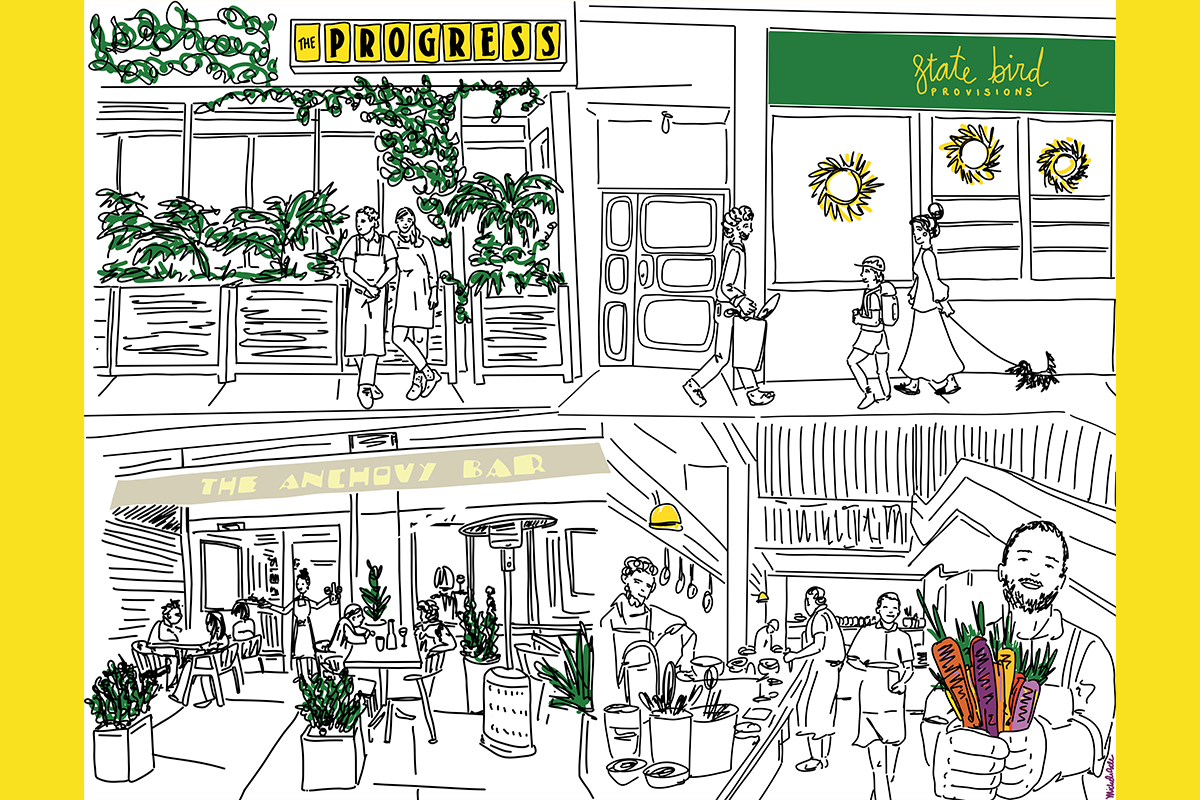
There’s a little insider trading happening at Chefs Stuart Brioza’s and Nicole Krasinski’s restaurants. “Insider trading” is the lighthearted way the chef team at Atomic Workshop—the restaurant group that includes The Progress, State Bird Provisions, and The Anchovy Bar—refers to how they share resources across different restaurants with their own identities.
Their guiding philosophy? Use sustainable, hyper-local ingredients and respect them enough to not let them go to waste. “I was trying to crack this code in cooking,” says Brioza. “How do you truly manage waste and become a very sustainable restaurant where everything, every bit and bobble that comes in, can be turned into something?”
“The compost bin is a missed creative opportunity” is a Brioza-ism heard often around the three restaurants. So, what does that look like in practice? It looks like the commissary kitchen or “the Workshop,” which spans the upper floors connecting The Progress and State Bird Provisions. The team there is primarily in charge of animal fabrication, dough work (there’s a separate pastry team which takes care of breads and desserts), sauce-making, and fermentation projects like the long-beloved sauerkraut and kimchi. They are also responsible for managing the protein pars at each restaurant and strategizing how to make the most of whole animals while maintaining peak freshness. For example, two locally caught, 150-pound bluefin tuna can end up as primary cuts for The Progress, a crudo on State Bird’s menu, and eventually, a meatball at The Anchovy Bar. Its bones? They’re in a broth. Short of its soul, every “atom” of the tuna is on a plate somewhere.
Because each restaurant is its own financial entity with its own individual P&L sheets, the trading among each place still comes with a technical cost. For example, the trim from veal quarters, currently on the menu at The Progress, will get technically “sold” to State Bird Provisions for a charcuterie of some kind, at a friendly price, even though it may not even change hands.
It’s not just proteins that get this treatment, produce is equally important. Chef Ashwin Oon, the chef de cuisine of State Bird Provisions, says that even the peels of kishu mandarins have become a prized dehydrated powder, rescued nobly from the compost heap. All that stone fruit that came in by the bushel this summer? Pastry Chef Lisa Chan, the group’s executive pastry chef, takes the fruit not fit for service and turns it into jams which she transforms into different desserts, thinning them out with different types of spirits or teas to fold into creams or cake batters. Instrumental to the commissary’s operations is Chef Gus Chavez, the executive sous chef of the Workshop, who coordinates these projects, communicates with suppliers, and strategizes with each head chef.

Chef Ashwin Oon’s Brown Butter-Roasted Morels, Lentil Dal Purée, Avocado-Galangal Chutney, Curry Leaf-Fried Shallot Condiment, Sweet Peppers, Lime Juice, Fried Shallots, Mustard Seeds, Microgreens
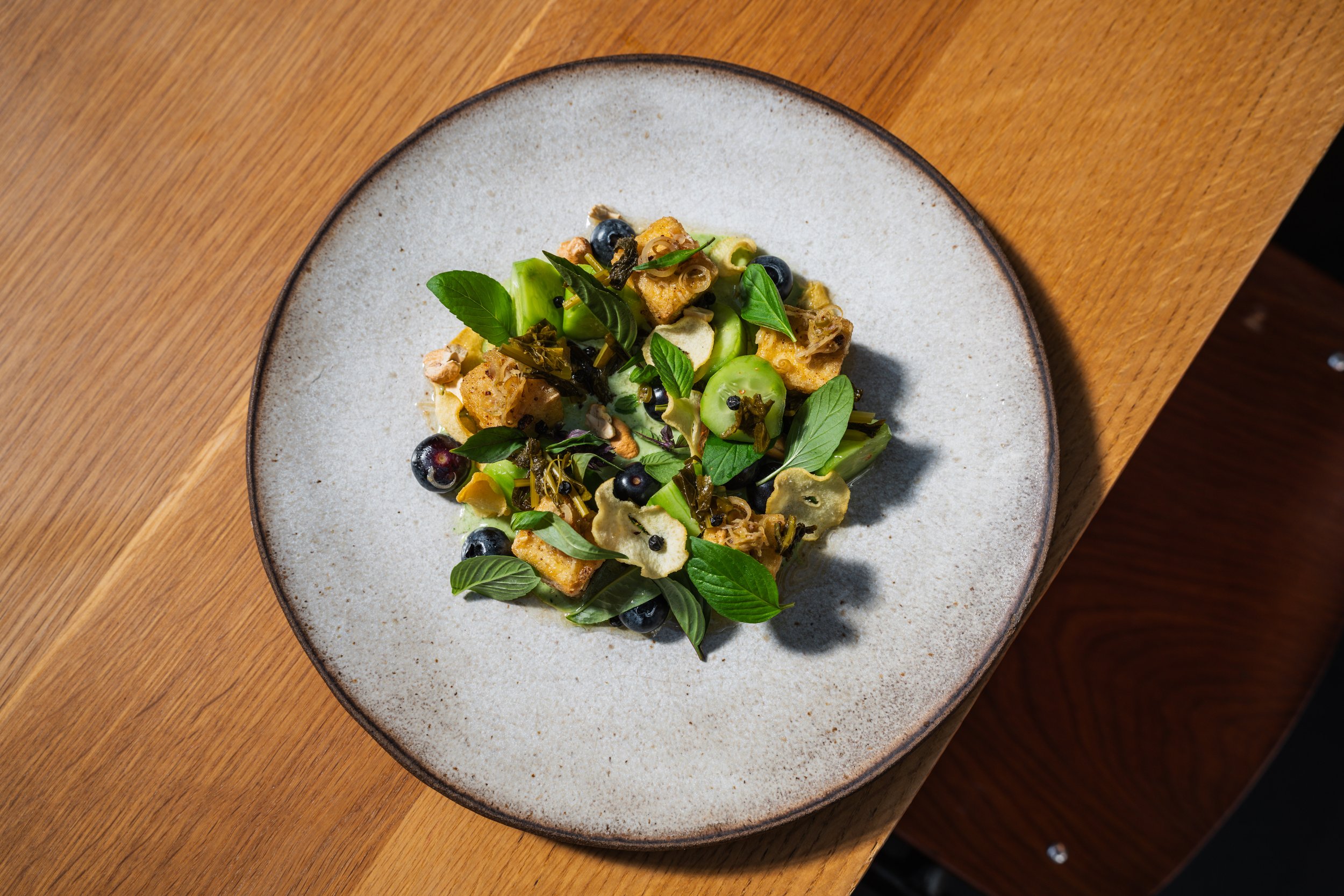
Chef Hans Lund’s Fried Tofu, Thai Chile-Rau Răm-Cashew Green Curry Sauce, Cucumbers, Lemongrass, Green Garlic, Pickled Blueberries, Fermented Turnip Greens, Vietnamese Cashews, Garlic Chips, Salted Kampot Pepper, Galangal Oil, Rau Răm, Thai Basil, Vietnamese Mint
Chef Hans Lund, executive chef of The Progress, describes the commissary as “the cerebral cortex or spine” of the entire restaurant group. When Chef Tif Thomasz of The Anchovy Bar gives tours of the space, she introduces the commissary kitchen to new cooks as “the heart of the operation.” When the commissary team arrives at 8:00 am, they light the proverbial hearth: they do a clean sweep of each restaurant, pour oil into fryers, turn on ovens, and get the three restaurants teed up for the day. “I want everyone to walk into spaces that are ready to welcome them. No matter if you’re a guest or if you’re an employee,” says Brioza. After tackling big prep jobs, the team helps the line of each restaurant get set up (if needed) and offers hands for the first push of, say, a busy Saturday night.
The commissary kitchen operates in a similar fashion to the atelier of a couture house—fine detailed projects happen in the Workshop so that the chefs across the executive team have the time and clarity to think seasons ahead. “It allows us to really flex,” says Brioza. “We count on them to do certain things, and so that our chefs can focus on being creative, making sure that our staff is being mentored and taught properly.” Chavez and the commissary kitchen also offer strategic relief in troubleshooting with suppliers.
“As the head chefs of our individual restaurants, we are tapped into our own environment and this ecosystem that we have, but the commissary is very tapped into like the supplier world,” says Thomasz.
While the chefs touch base daily with the commissary kitchen, this information also flows through weekly bulletins that track everything from staffing to ingredient spotlights and answers questions about what to do with extra product. The result is an open-thread of dialogue that helps incubate creativity and, in effect, make a group of 130 employees feel intimately connected.
“We’re big overcommunicators,” says Brioza. It also ensures that when each chef simultaneously and inexplicably decides to menu kimchi, they don’t run out in a day, which is, according to legend, kind of how the whole bulletin system started.
“We want to connect and share ideas all the time and that’s what food is about,” says Thomasz. “It’s not one chef trying to showcase what they can do. It’s two or three people behind it talking about it and sharing what they care about, and the dish is the end product of what we share with each other.”

Chef Tif Thomasz’s Halibut Crudo, Aprium-Fresno Salsa, Fish Sauce Vinaigrette, Serrano Peppers, Scallions, Fried Wild Rice

Chef Hands Lund’s Hokkaido Scallop Crudo, Cherimoya-Lime Puree, Compressed Chayote, Avocado, Scallions, Pomelo, Lime, Smoked Poblano Salsa Seca, Purple Sweet Potato Chips
While in some kitchens, a prep position might be an entry-level way into a restaurant, at Atomic Workshop, it’s a way for cooks who show promise to grow, hone their technique, and get a broader picture of the back-of-house systems and operations of the group. “I think that for the line cooks who want to grow and really have a holistic understanding, the commissary kitchen gives you a much wider view of what’s happening in the restaurant as a whole and how those things are being utilized across all three restaurants,” says Chavez. That typically looks like starting on the line at one of the restaurants, moving to the commissary kitchen to be a saucier or butcher, before becoming a sous chef and so forth.
“The commissary kitchen has really helped create this ecosystem of knowledge and growth and it’s almost a graduate program in a way,” says Lund.
Oon says that unlike other prep cook positions that might be the starting point for entering a restaurant, it’s the opposite at the Workshop. “We move people to the commissary as an option after completing or mastering the stations in the restaurants,” he says. Particularly appealing to cooks is the opportunity to delve into whole animal butchery and more complex sauce work—two fundamental building blocks of becoming a chef.
In addition to the opportunities it provides for learning, the commissary kitchen along with the restaurants creates a safety net without needing to sacrifice the ambitious ideas of its chefs. “We don’t throw somebody into the fire to see if they get burned,” says Brioza. “We teach them how to start a fire, and we teach them how to manage the fire.”
Lund agrees: “The commissary kitchen allows for a better work culture in terms of pressure relief valve of support.”
The commissary grew slowly and organically, evolving after The Progress opened in 2014. As costs rise for restaurants, Brioza says its next evolution is in its continued streamlining. “One topic that we’re really talking about right now is this simplify-to-amplify process,” he says. “It’s very important to the future of what we’re doing as costs are rising [and] as labor is becoming harder to find.”
This philosophy, like everything at the Workshop, extends to Brioza’s interactions with cooks eager to add their creative voice into the mix. “When you’re a young cook, you want to put everything but the kitchen sink on a plate,” says Brioza. “As a wiser chef, I’m at a point where I can be like, ‘hey, stop now. This is great.’”