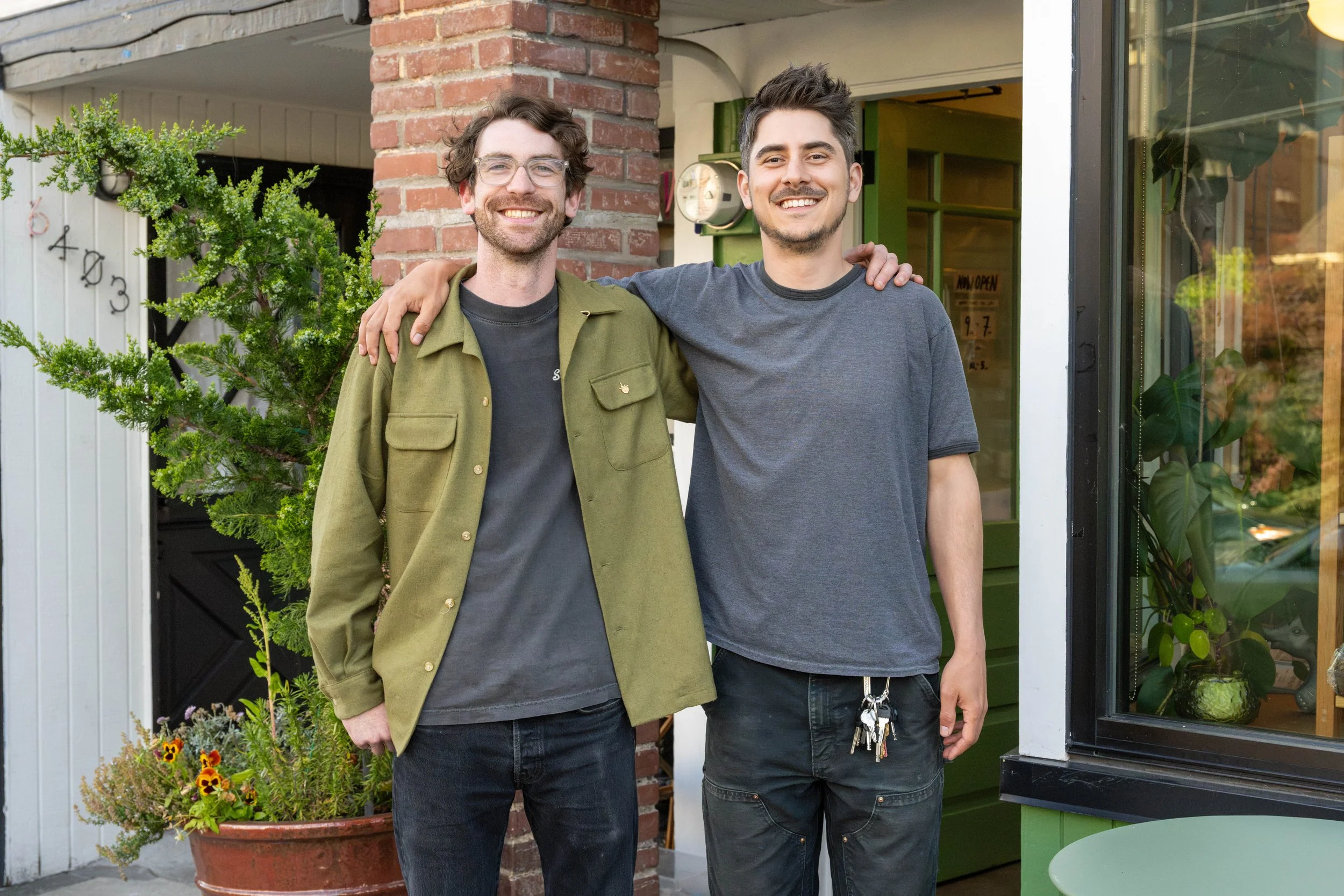
Chef Chris Shepherd and Lindsey Brown discuss the non-profit’s past, present, and future.
Since moving to Houston nearly 30 years ago, Chef-Restaurateur Chris Shepherd has become one of the city's most vocal advocates and well-known culinary figures. Shepherd, who spent his early career cooking at Brennan’s and Catalan, built a hospitality group of his own with acclaimed restaurants like The Hay Merchant and Underbelly.
Since then, he has written for publications like Food & Wine, launched a hot dog and sausage company, and now hosts a TV show on Houston’s local NBC affiliate station. Beyond these front-facing endeavors, Shepherd has also dedicated countless hours to his charity, the Southern Smoke Foundation, which raises money for emergency relief funds and mental health care for food and beverage professionals across the country. StarChefs Staff Writer Jason Lyons sat down with Shepherd and his wife, Southern Smoke’s Executive Director Lindsey Brown, to talk about the organization, its annual festival, and the future of Houston’s hospitality industry.
Jason Lyons: Could you start by telling me about the origins of the organization? How did the Southern Smoke Foundation start?
Chris Shepherd: We were doing dinners at Underbelly to raise money for kids to go to culinary school. We did roughly five dinners, which was cool, but it was short-lived because the sommelier that was helping us, Antonio [Gianola], came to me and asked to do a dinner to raise money for multiple sclerosis (MS). I asked, why? And he said he was diagnosed with it that week. We had lost a young chef to suicide before that, who also had MS and didn’t tell anyone. Antonio wanted people to know what was going on with him. [The dinner] turned into a festival, with about 800 people or so. The goal was to raise $100,000. We raised $180,000. The next year, we raised $284,000.
Then we were doing it again when Hurricane Harvey came through. It took a big toll on the city, but there were already millions of dollars being raised. Knowing it was never going to hit the hands of a drive-through worker or a farmer or a cook, we looked at each other and said, ‘We need to take care of people in our industry.’ People lost their whole farms, their homes. So, we put an application together and formed a committee. We took on 230 applications. 139 families [were] funded. Half a million dollars [distributed]. We made it to the point where we were going to continue with food and beverage assistance, and that's where we are at now. We have granted about 15 million dollars across the country.
JL: What were the initial goals of the organization? Why were they particularly important to you, and how have they changed or developed over time?
CS: Back in 2018, we had this growth. We went from four chefs to eight chefs to 12 to 18 [working with us]. And after the passing of Anthony Bourdain, one of my chefs said we have the opportunity to make an impact. So, we held a closed-door lunch with those chefs and focused on things we can do before the problems happen. Mental health was where we landed. We just didn't know how to do it. How do we get access for everyone? What we found and what we did—the silver lining of the pandemic—is we [started] working with Mental Health America. At the University of Houston, PhD students couldn't get their clinical hours during the pandemic. Mental Health America put us together. We figured out a system. You know the way boosters fund college football teams? Well, we fund the psychology department. We pay the university so we get free clinical hours. So, anyone who enrolls in the Behind You program has access to 20 free sessions or six months of care, and a sliding scale at the end of that. The system and learning manual that the University of Houston uses, a lot of people use that same learning manual from the APTC (the Association of Psychological Training Clinics). So we could use that same program and go state to state. Now we are in 10 states and going into three more this year.
How can we do better? That's how it works. How can we increase our ability to take care of our industry? A little bit more and a little bit more and a little bit more. Once we get to 50 states and mental health [care] across the country, we will start working on free legal [support].
JL: How has the organization grown over the last five years?
Lindsey Brown: We technically have offered emergency relief to all 50 states since the beginning. Just didn't have the awareness like we do now. So, our goal has always been to assist anyone who qualifies and needs the funding. As awareness grows, our funding resources need to grow. We are seeing larger partnerships with large restaurant groups. We are their charity of choice. Every dollar comes to us. So, if there is something wrong with their employees, they send them to us. It’s a beneficial relationship. We had a situation in North Carolina where a large group of food and beverage workers decided that they wanted a mental health care program. They committed, as a coalition, to fundraise for it. Now, we are negotiating contracts with a major university in North Carolina, and we have money in the bank because these food and beverage workers made it happen [on their own]. It's incredible. We are using North Carolina as a template for other coalitions in other states. Once it launches in North Carolina, [we know] that people will get the mental health counseling that they want. It's really cool.
JL: Has the Southern Smoke Festival raised the national profile of the Houston hospitality community?
CS: They get the chance to learn and talk. A lot of the Houston chefs don't get to travel to these kinds of events to meet these people. When we first started, we just brought the national chefs, and local chefs would help and support. It was more like, we want people to understand Houston. Now, it's like, shit, we want everybody! People are like, I want to come, but we look at people who are working with the organization. If you just want to come hang out at the festival, then buy a ticket. We need people to help fund it. People are like, what's the magic behind it? Nothing. If you want to be a part of it, be a part of it, don’t just come for the weekend.
JL: How do you hope to see the organization grow over the next few years?
CS: When we started, I didn't think this would even be around five years. Hopefully there will be a [government] safety net to help the industry, but I don't think that's happening anytime soon. No matter who is in office. We saw, during the pandemic, airlines got money, and some restaurants got money, but not enough to cover the bill. It is what it is, but we don't take government money so that we can do what we want to do.
LB: As long as you have taxable income and meet our employment eligibility guidelines, we can fund you. So, then, a lot of our mental health partners have been trained how to deal with fear and anxiety related to immigration issues and ICE coming to restaurants. Any way we can support the community, [which] is so dependent on immigrants, that's what we are here for. We support the food and beverage industry. We support everyone in that industry.
JL: How do you hope the hospitality industry continues to change in the future?
CS: We are seeing a stigma of mental health going away, but it takes big leaders to step up and say it's ok. I went to the rodeo back in February to poke around and look for [agricultural] communities to work with, and there were farmers for mental health and ranchers for mental health. I'm like, hell yeah, right on! We need that. I can't remember a time when I was a cook, working sauté or grill, and saying to the cook next to me, do you have a therapist? How do I find one?
JL: How can people across the country make a similar kind of impact in their own communities?
CS: We didn't expect this. The pandemic made it this big. We had the systems set up. We had the ability to fund people. And when Tito’s gave us a check, and David Chang won the million dollars [for Southern Smoke] on Who Wants to Be a Millionaire, they did it because they knew it was going to the right hands. So, anyone that wants to start something, do it. There is no 'just trying.' You have to figure out what that thing is and do it.